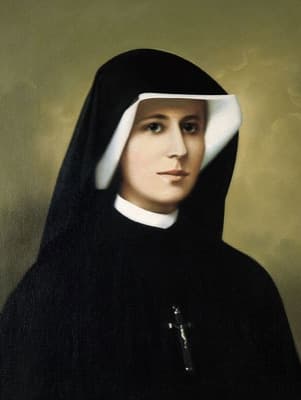
The Divine Mercy Novena was given by Jesus to St. Maria Faustina Kowalska, a Polish nun of the Congregation of the Sisters of Our Lady of Mercy, in a series of revelations recorded in her Diary: Divine Mercy in My Soul. Faustina's mystical writings, suppressed for a time after her death in 1938, were vindicated by Pope St. John Paul II — himself a Pole and a fellow countryman — who canonized her on April 30, 2000, and established Divine Mercy Sunday (the second Sunday of Easter) as a feast for the universal Church. The novena begins on Good Friday and concludes on the eve of Divine Mercy Sunday, drawing the eight days of Easter Week into a single sustained intercession. Each of the nine days, Jesus instructed Faustina, brings a different category of souls before the throne of mercy: Day 1 all mankind, Day 2 priests and religious, Day 3 devout and faithful souls, Day 4 those who do not believe, Day 5 the souls of separated brethren, Day 6 the meek and humble and children, Day 7 souls who venerate Divine Mercy, Day 8 the souls in purgatory, Day 9 lukewarm souls. This pattern — beginning with all humanity, narrowing through the family of the Church, and closing with those whose hearts are coldest — embodies the breadth of the mercy this devotion proclaims. The novena's spiritual home is the Sanctuary of Divine Mercy in Łagiewniki, Kraków, where Faustina lived, died, and is now entombed, and where a daily live broadcast of the chaplet at the Hour of Mercy (3:00 PM) reaches millions worldwide.
Anonymous photograph, c. 1930s
20 min
Duration
9 days
Commitment
Intermediate
Level
St. Faustina Kowalska
Patron Saint
How to Pray
Pray once daily for nine consecutive days, traditionally beginning on Good Friday and ending on the Saturday before Divine Mercy Sunday. Each day has a unique intention (specified above) and a unique opening invocation that Jesus dictated to St. Faustina; after the day's opening, the prayer concludes with the Chaplet of Divine Mercy (see the separate Chaplet of Divine Mercy entry for full instructions). The traditional structure for each day: (1) Read or recall the day's specific intention; (2) Pray the opening prayer Jesus gave Faustina for that day; (3) Pray the Chaplet of Divine Mercy in full; (4) Close with a personal intention. The full novena takes approximately fifteen minutes per day. Though the novena is traditionally tied to the Good Friday → Divine Mercy Sunday window of Easter, it may also be prayed at any time of year for a private intention, especially in moments of crisis or for the conversion of a loved one. The Sanctuary of Divine Mercy in Łagiewniki and the National Shrine of Divine Mercy in Stockbridge, Massachusetts, both offer daily public recitation of the chaplet at the 3:00 PM Hour of Mercy and accept written intercessory prayer requests. The chaplet may be prayed alone, with family, or in a group; it is also the prayer most commonly offered at the bedside of the dying by Catholic hospital chaplains and hospice volunteers.
Prayer Text
You expired, Jesus, but the source of life gushed forth for souls, and the ocean of mercy opened up for the whole world. O Fount of Life, unfathomable Divine Mercy, envelop the whole world and empty Yourself out upon us. O Blood and Water, which gushed forth from the Heart of Jesus as a fount of mercy for us, I trust in You!
Recommended For
ConversionGrief & LossGeneral IntentionMental Health
Coordinate sustained prayer for someone you love. Volunteers fill 30-minute slots covering days or weeks; the family receives a spiritual bouquet at the end.