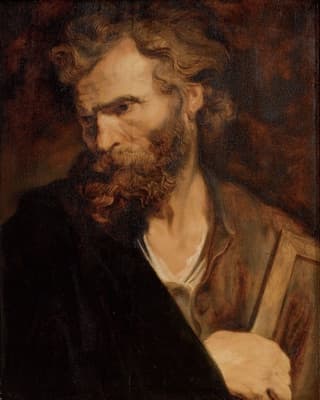
St. Jude Thaddeus, called the Apostle of Hope, was one of the Twelve and a kinsman of the Lord, traditionally counted a brother of James the Less and a cousin of Jesus. He is named in the Gospels as one of the apostles (Luke 6:16) and is the author of the brief Epistle of Jude that closes the New Testament's catholic-letter section — a letter that famously urges believers to 'contend earnestly for the faith.' For centuries, popular Catholic devotion has invoked St. Jude as the patron of desperate cases and impossible causes. The reasons offered by tradition are practical: because his name (Jude / Judas) was easily confused with Judas Iscariot, the betrayer, his intercession was avoided by ordinary Christians for centuries — and so, the saying goes, he longs to help anyone who turns to him in real need. The modern Catholic devotion to St. Jude was popularized in the United States by the Claretian fathers, who built the National Shrine of St. Jude in Chicago in 1929 — at the height of the Great Depression — and the shrine remains one of the most-visited Catholic pilgrimage sites in North America. The devotion is strongly associated with the practice of publishing thanksgivings ('Thank you, St. Jude, for prayers answered') in newspaper classifieds, a custom that began in mid-twentieth-century American Catholic culture and continues quietly to this day. This novena is fitting for illness with poor prognosis, financial collapse, family estrangement that seems beyond reach, infertility, and any situation a person experiences as 'beyond hope.'
Anthony van Dyck (c. 1618–1620)
10 min
Duration
9 days
Commitment
Beginner-Friendly
Level
St. Jude Thaddeus
Patron Saint
How to Pray
Pray once daily for nine consecutive days. The traditional structure: begin with the Sign of the Cross; pray the St. Jude novena text; conclude with an Our Father, Hail Mary, and Glory Be; name your specific intention silently or aloud. Many Catholics add three additional Our Fathers, Hail Marys, and Glory Bes in honor of the Trinity at the close of each day's prayer. The novena may be prayed at any time of year but is especially appropriate in the nine days leading up to St. Jude's feast (October 28, shared with St. Simon the Zealot) or whenever someone faces a situation that feels 'impossible.' A traditional companion practice is to commit, when the prayer is heard, to publicly thank St. Jude — either through a published thanksgiving (the classified-ad tradition), a donation to a St. Jude apostolate, or simply by encouraging devotion to him within one's family and parish. The Claretian National Shrine of St. Jude in Chicago accepts intercessory prayer requests by mail and online and continues a perpetual novena to St. Jude that has been prayed daily since 1929. If a day of the novena is missed, traditional counsel is to begin again from day one. The disposition of the prayer matters: St. Jude is not a vending machine. The novena is prayed in faith and surrender, trusting that the Holy Spirit knows what the petitioner truly needs and that the saints intercede for what is good, not always for what is wanted.
Prayer Text
Most holy apostle, St. Jude, faithful servant and friend of Jesus, the Church honors and invokes you universally as the patron of hope. Please intercede on my behalf. Make use of that particular privilege given to you to bring hope, comfort, and help where they are needed most. Come to my assistance in this great need that I may receive the consolation and help of heaven as I work with my challenges, particularly (mention your intention). I praise God with you and all the saints forever. I promise, blessed St. Jude, to be ever mindful of this great favor, to always honor you as my special and powerful patron, and to gratefully encourage devotion to you. Amen.
Coordinate sustained prayer for someone you love. Volunteers fill 30-minute slots covering days or weeks; the family receives a spiritual bouquet at the end.