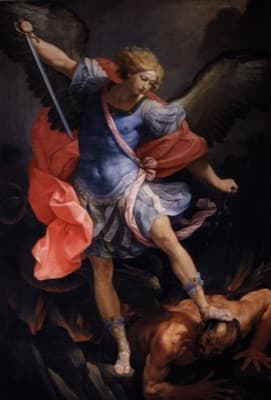
The Prayer to St. Michael the Archangel was composed by Pope Leo XIII in 1886 after, according to long-attested tradition, the Pope had a sudden mystical experience while celebrating Mass — a kind of waking vision in which he overheard a colloquy between Christ and Satan in which Satan boasted he could destroy the Church if granted enough time and power. Shaken by what he had seen, Leo XIII composed the prayer to St. Michael that same day and ordered it added to the prayers said by the priest and faithful at the end of every Low Mass throughout the universal Church. This practice — the 'Leonine Prayers' after Mass — continued for nearly eighty years until the liturgical reforms of the 1960s. The St. Michael prayer was not abolished but its formal place in the post-Mass prayers was lapsed. Pope St. John Paul II revived the prayer's prominence in a 1994 Sunday Angelus address, in which he urged the faithful to 'not forget to recite' the St. Michael prayer 'to obtain help in the battle against the forces of darkness and against the spirit of this world.' The prayer's text draws on Jude 1:9 (Michael disputing with the devil over the body of Moses), Revelation 12:7-9 (Michael casting down the dragon), and the broader Catholic tradition of St. Michael as the leader of the heavenly host against the powers of evil. The prayer is appropriate for: spiritual warfare in any form, anxiety about evil in the world or in personal life, protection during travel or before a difficult encounter, the conversion of those who have fallen into serious sin, and as a daily prayer of consecration to St. Michael's protection. It is the prayer most commonly taught to Catholic children as a first 'protection prayer' alongside the Guardian Angel Prayer.
Guido Reni (c. 1635)
1 min
Duration
1 day
Commitment
Beginner-Friendly
Level
St. Michael the Archangel
Patron Saint
How to Pray
Pray once with full attention and devotion. The Prayer to St. Michael is short enough to commit to memory and to pray anywhere — in the car before a difficult meeting, at the door of a hospital, walking past a place where one senses spiritual discord, before bed at the end of the day. The traditional Catholic practice — and the one Leo XIII originally instituted — is to pray it immediately after the conclusion of Holy Mass, either in the silence following the dismissal or as part of a public sequence of Leonine Prayers. Many parishes have revived the post-Mass St. Michael prayer in the wake of JPII's 1994 call; if your parish does not, it is entirely appropriate to remain in your pew for thirty seconds after the dismissal and pray it privately. The prayer is also frequently included: at the close of the Rosary or a Holy Hour; at the conclusion of family night prayer; before any task in which a Catholic senses real spiritual opposition. Some Catholic households post the prayer above the front door of the home as a sign of consecration to St. Michael's protection of the household, in continuity with the older tradition of inscribing 'Christus vincit, Christus regnat, Christus imperat' ('Christ conquers, Christ reigns, Christ commands') over thresholds. The prayer pairs naturally with the Guardian Angel Prayer for children: St. Michael as the prince of the angelic host, and the guardian angel as the particular ministering spirit assigned to each person at baptism.
Prayer Text
St. Michael the Archangel, defend us in battle. Be our protection against the wickedness and snares of the devil. May God rebuke him, we humbly pray; and do thou, O Prince of the heavenly host, by the power of God, thrust into hell Satan and all the evil spirits who prowl about the world seeking the ruin of souls. Amen.
Coordinate sustained prayer for someone you love. Volunteers fill 30-minute slots covering days or weeks; the family receives a spiritual bouquet at the end.