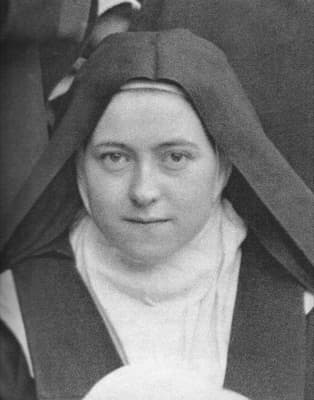
St. Therese of the Child Jesus and the Holy Face — better known as Therese of Lisieux, or the Little Flower — was a Discalced Carmelite nun who entered the cloister at Lisieux, Normandy, at age fifteen and died of tuberculosis at twenty-four (1873-1897). Her spiritual autobiography, Story of a Soul, was published shortly after her death and quickly became one of the most-read Catholic books of the modern era. From the obscurity of a provincial cloister she taught what she called the Little Way: confidence in God's merciful love expressed in the smallest acts of daily fidelity, rather than in heroic external feats. 'I will spend my heaven doing good upon the earth,' she famously promised, 'I will let fall a shower of roses.' The 'shower of roses' tradition — the belief that intercessions answered through St. Therese are often accompanied by an unexpected rose, literal or symbolic — has shaped Catholic devotion to her ever since. She was canonized by Pope Pius XI in 1925, named Patroness of the Missions in 1927 (despite never leaving the cloister), and proclaimed a Doctor of the Church by Pope St. John Paul II in 1997 — one of only four women so named, alongside Sts. Teresa of Ávila, Catherine of Siena, and Hildegard of Bingen. Her doctrinal contribution is the theology of childhood: the Gospel teaching that one must become like a little child to enter the Kingdom (Matthew 18:3) given a sustained, contemplative articulation. The novena to St. Therese is appropriate for: discernment of religious or lay vocation, recovery from illness (her own tuberculosis was endured with great suffering), spiritual aridity, the conversion of distant loved ones (she prayed continually for Pranzini, a condemned murderer, as her 'first child'), and any moment a soul senses its own smallness in the face of a large need.
Photograph by Céline Martin (c. 1894)
10 min
Duration
9 days
Commitment
Beginner-Friendly
Level
St. Therese of Lisieux
Patron Saint
How to Pray
Pray once daily for nine consecutive days. The traditional structure: (1) Begin with the Sign of the Cross; (2) Pray the novena prayer to St. Therese (asking her intercession and her famous rose); (3) Name your intention silently or aloud; (4) Conclude with an Our Father, Hail Mary, and Glory Be. The novena is appropriately prayed in the nine days leading up to her feast (October 1) or at any time during the year for a private intention. Many Catholics keep a small picture or relic of St. Therese in the home or carry a rose-themed prayer card during the novena. The 'shower of roses' tradition is exactly that — a tradition, not a magical guarantee. A rose received during or after the novena is read as a personal sign that the saint has heard the prayer and is interceding before Christ; the absence of a rose is not read as the absence of intercession. The point is the disposition: Therese's Little Way invites the petitioner into the same childlike trust she modeled, which is itself the grace being asked. The novena is also a fitting companion to specific acts of small fidelity during the nine days — patience with a difficult family member, accepting a small inconvenience without complaint, holding back a sharp word, performing one hidden act of kindness daily. These 'little ways' embody what the novena petitions: not heroic transformation, but the path of small things done with great love that Therese taught and lived.
Prayer Text
O Little Therese of the Child Jesus, please pick for me a rose from the heavenly gardens and send it to me as a message of love. O Little Flower of Jesus, ask God today to grant the favors I now place with confidence in your hands. (Mention your intention.) St. Therese, help me to always believe, as you did, in God's great love for me, so that I might imitate your Little Way each day. Amen.
Coordinate sustained prayer for someone you love. Volunteers fill 30-minute slots covering days or weeks; the family receives a spiritual bouquet at the end.